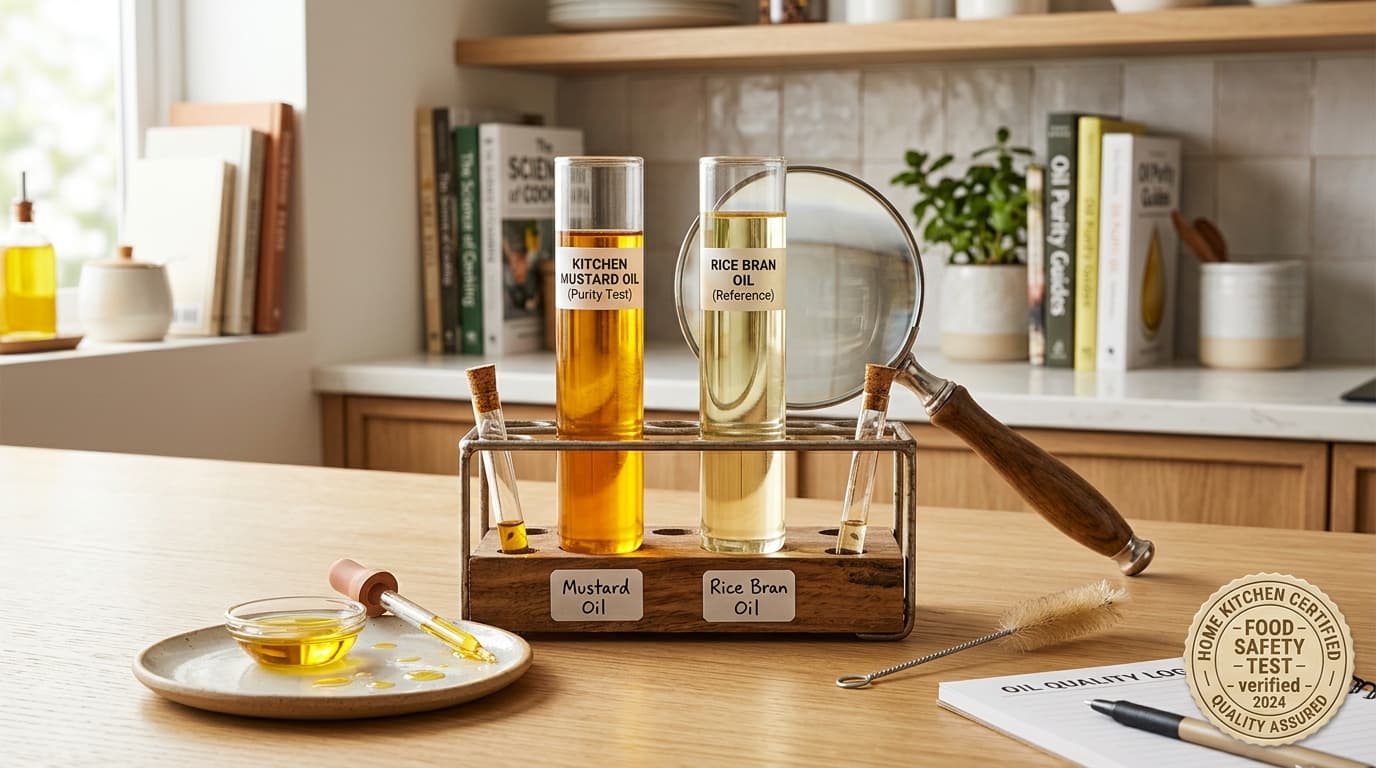
“Edible oil adulteration with toxic Argemone seed oil, mineral oils, or cheap palm olein poses severe health risks including epidemic dropsy and cardiac toxicity. Using FSSAI-approved simple home tests helps you verify the safety of your family's daily cooking oil.”
In Indian markets, edible oil adulteration remains a persistent consumer concern. From loose mustard oil tainted with poisonous Argemone mexicana seeds to refined oils secretly diluted with cheap saturated palm fats or synthetic coloring dyes, knowing how to verify purity is an essential home safety skill.
The Food Safety and Standards Authority of India (FSSAI) has published the DART (Detect Adulteration with Rapid Test) handbook to empower citizens to test food safety at home. Below is the complete step-by-step testing manual, along with insights from our certified NABL testing laboratory in Burdwan.
Test 1: Detecting Toxic Argemone Oil in Mustard Oil
Argemone mexicana is a wild weed with seeds resembling mustard seeds. When mixed into mustard oil, its toxic alkaloids (sanguinarine and dihydrosanguinarine) cause severe capillary dilation, fluid retention, gastrointestinal distress, and cardiac complications (Epidemic Dropsy).
FSSAI Rapid Nitric Acid Procedure:
- Take 5 ml of the mustard oil sample in a clean, dry glass test tube or transparent glass.
- Carefully add 5 ml of concentrated Nitric Acid ($HNO_3$).
- Shake the tube gently and let it stand undisturbed for 2 to 3 minutes.
- Interpretation:
- Adulterated: A distinct reddish-brown or crimson-red ring/layer appears at the separation zone.
- Pure: No red color develops; the oil layer maintains its natural golden-yellow tone.
Safety Note: Nitric acid is a corrosive chemical. Always handle with protective gloves and eye protection in a well-ventilated area, and keep away from children.
Test 2: Detecting Cheap Palm Oil / Triacylglycerol Solid Fraction Dilution
Unscrupulous sellers often blend refined oils with inexpensive palm stearin or recycled hydrogenated fats to increase profit margins.
The Refrigerator Freezing Test:
- Pour 50 ml of your cooking oil into a small, dry glass jar.
- Place the jar in your refrigerator chiller section (approx. 4°C to 8°C) for 2 to 3 hours.
- Interpretation:
- Adulterated: High-melting saturated palm fats will freeze quickly, creating a thick, white cloudy precipitate or solid layer at the bottom.
- Pure: High-purity winterized Rice Bran Oil and Kacchi Ghani Mustard Oil remain uniformly clear and liquid.
Test 3: Detecting Mineral Oil / Prohibited Non-Edible Lubricants
Mineral oils are cheap hydrocarbon distillates completely indigestible by humans and banned in all edible oils by the FSSAI.
The Alcoholic KOH Turbidity Test:
- Take 2 ml of oil and add 2 ml of 0.5N Alcoholic Potassium Hydroxide (KOH).
- Boil in a water bath for 15 minutes, then add 10 ml of distilled water.
- Interpretation: Pure edible triglycerides saponify completely into a transparent soap solution. If mineral hydrocarbons are present, the solution turns instantly milky and turbid.
4. The Institutional Guarantee: In-House NABL Lab Verification
While home rapid tests provide quick consumer verification, laboratory-grade gas chromatography (GC) and spectrophotometric assays ensure comprehensive molecular purity.
Every single production batch of Jeevan Rekha Foods at AB Udyog undergoes rigorous testing in our NABL-Accredited Analytical Quality Laboratory in Burdwan, West Bengal:
- Argemone Oil Test: 100% Negative (Gas Chromatography verified).
- Mineral Oil & Castor Oil: 100% Negative (Nil residue).
- Free Fatty Acids (FFA): ≤ 0.089% (Far stricter than standard FSSAI 0.25% limits).
- Peroxide Value: ≤ 0.56 meq/kg (Zero rancidity guarantee).
Read our full Kacchi Ghani vs Refined Mustard Oil analysis to understand how authentic cold screw-pressing preserves purity and natural pungency.