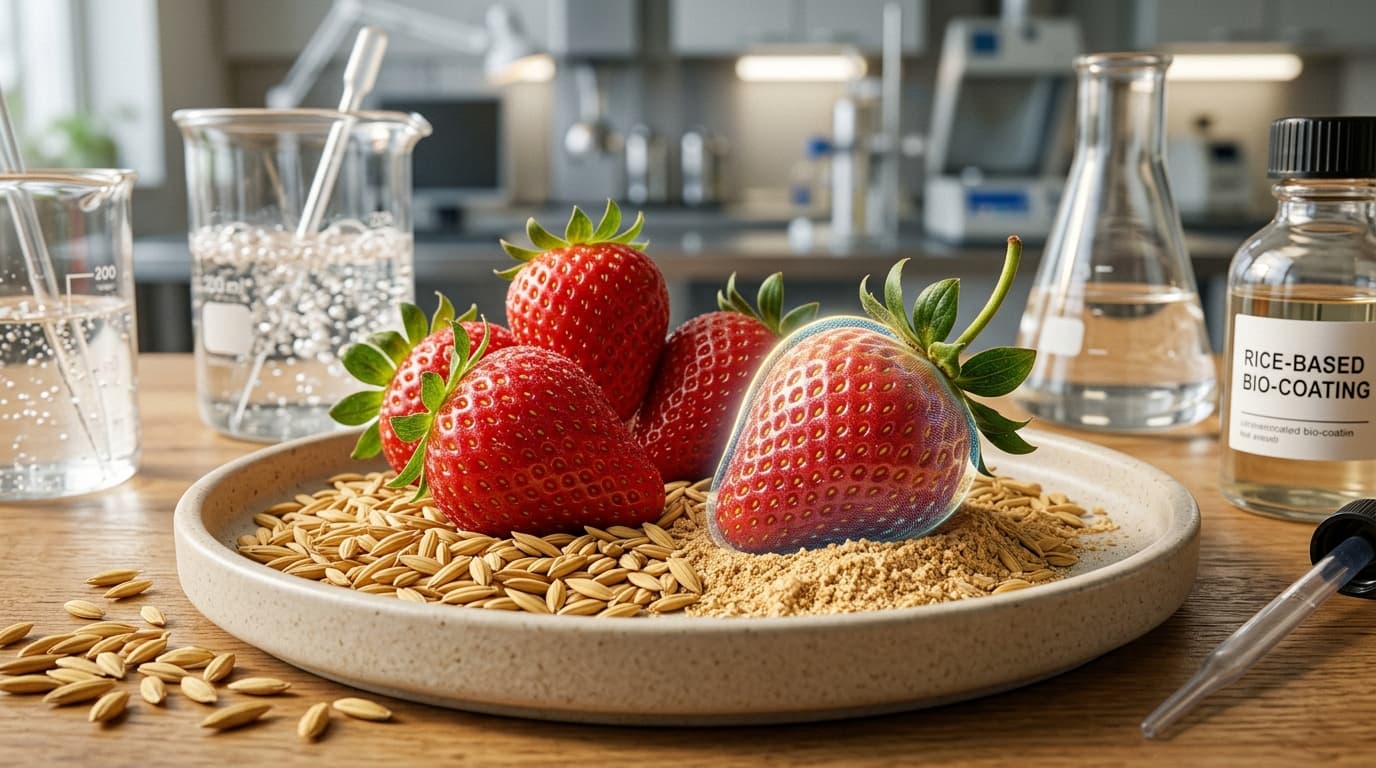
“Agricultural residues are no longer waste. By extracting natural biopolymers from rice bran oil cake using clean microwave water-extraction at pH 6.5, Indian researchers have achieved an 86.4% yield of functional polysaccharides—formulating an edible antimicrobial nano-coating that protects fresh fruit without synthetic petroleum waxes.”
When we extract heart-healthy cooking oil from the nutrient-dense aleurone layer of brown rice, a protein- and fiber-rich substance remains: Rice Bran Oil Cake (RBOC), known commercially in Indian agriculture as De-Oiled Rice Bran (DORB).
Historically, over 9 million metric tons of this co-product were generated annually in India, with the vast majority sold at nominal prices as cattle feed, aquaculture fodder, or industrial boiler fuel.
However, an independent 2025 peer-reviewed study published in the prestigious international journal Food Bioscience (Elsevier) by food researchers at Lovely Professional University proves that this agricultural byproduct is an untapped goldmine of high-performance natural biopolymers. Using green, microwave-assisted aqueous technology, the scientists isolated plant polysaccharides and proteins to engineer an antimicrobial edible nano-coating that substantially extends the shelf-life of fresh strawberries against bacteria, yeast, and fungal rot.
Can the byproduct of your cooking oil bottle hold the secret to eliminating toxic synthetic fruit waxes worldwide?
The Core Scientific Data: Uncompromised Lab Findings
To maintain complete scientific integrity, the table below documents the exact physical, chemical, and techno-functional measurements published by Salaria et al. (2025) in Food Bioscience:
| Physicochemical Parameter | Published Lab Value | Food Tech & Practical Significance |
|---|---|---|
| Maximum Extraction Yield | 86.39 ± 0.23% | Achieved at optimal near-neutral pH 6.5 using green microwave-assisted aqueous extraction. |
| Spray-Dried Extract Recovery | 48.13 ± 2.19% | Dry-basis fine white powder with low moisture content (7.12 ± 1.23%), ideal for stable industrial storage. |
| Nanoscale Droplet Size | 265.1 ± 5.06 nm | Nanoscale particle dimensions ensure an imperceptible, microscopic, and breathable surface film. |
| Polydispersity Index (PDI) | 0.384 | Demonstrates narrow, uniform droplet distribution across the colloidal suspension. |
| Zeta Potential (Electrostatic Charge) | −45.9 ± 0.25 mV | High negative electrical repulsion confirms outstanding colloidal stability (no curdling or phase separation). |
| Water-Holding Capacity (WHC) | 7.08 ± 0.4 g/g | Locks in moisture, preventing transpirational water loss and weight shrinkage in fresh produce. |
| Oil-Holding Capacity (OHC) | 4.32 ± 0.6 g/g | Facilitates the incorporation of natural lipid bioactives and essential oils. |
| Emulsifying Capacity & Stability | 93.50% / 95.65% | Forms an exceptionally durable, cohesive film barrier over delicate fruit epidermis. |
| Aqueous Solubility | 90.32 ± 1.67% | Enables effortless aqueous preparation and seamless consumer washability. |
1. The Food Technologist’s Lens: How Nanoemulsions Halt Spoilage
From a post-harvest biochemistry perspective, soft fruits like strawberries deteriorate within 48 to 72 hours under ambient conditions due to two concurrent biological processes:
- Rapid Transpirational Moisture Loss: Thin epidermises allow cellular water to evaporate, causing shrinking, loss of firmness, and collapse of Vitamin C (ascorbic acid).
- Aggressive Fungal Proliferation: Pathogens such as Botrytis cinerea (gray mold) and ambient bacteria easily colonize microscopic surface abrasions.
Respiration Barrier
The biopolymer nanoemulsion forms a semi-permeable lattice over the fruit stomata. It throttles excessive O₂ ingress and CO₂ egress, effectively putting the fruit into a gentle state of metabolic dormancy.
Antimicrobial Defense
The extracted polysaccharides (arabinoxylans, stachyose, and glucose complexes) combined with stabilized phenolic compounds disrupt microbial cell walls, inhibiting both yeast and mold proliferation on the strawberry skin.
2. The FSSAI Regulatory Officer’s Lens: Natural Biopolymers vs. Synthetic Chemical Waxes
In Indian urban markets, consumer vigilance surrounding edible fruit coatings is rising sharply. Many commercial apples, citrus fruits, and berries are coated with synthetic carnauba, shellac, morpholine, or chemical fungicides to endure transport and cold storage.
Under the Food Safety and Standards Authority of India (FSSAI) regulations:
- Artificial ripening agents (such as banned calcium carbide) and non-permitted mineral hydrocarbons are strictly prohibited due to chronic health risks.
- Surface coatings on perishable fruits must be 100% food-grade, clean-label, and safe for direct human digestion.
Why Rice Bran Biopolymer Is an Ideal FSSAI-Compliant Alternative:
100% Edible & Hypoallergenic: Unlike wheat gluten or soy protein isolates which trigger severe allergen warnings, rice bran proteins possess high biological value and are naturally hypoallergenic and gluten-free.
Zero Solvent Residues: Because extraction operates using pure water at pH 6.5 rather than hexane or chemical precipitating agents, the coating leaves zero petrochemical traces on the fruit surface.
3. From Lab to Industry: The Circular Bio-Economy in Action
Where does the raw material for such sustainable biotechnology originate? It begins right in India's agricultural heartlands.
In premier integrated processing ecosystems like AB Udyog Pvt. Ltd.in Burdwan—the historic “Rice Bowl of West Bengal”—every metric ton of paddy harvested yields multiple interconnected value streams:
De-Oiled Rice Bran (DORB)
Produced with a certified minimum 16.0% crude protein and low silica (<5.0%), AB Udyog DORB supplies aquaculture and livestock feeds, representing the exact high-purity feedstock evaluated in biopolymer research.
300 TPD Extraction Complex
Operating advanced continuous solvent extraction, multi-stage desolventizer-toasters, and steam recovery, the Burdwan processing infrastructure ensures total quality control across both oil and solid meals.
100% Physical Refining: Preserving the Oil, Enriching the Grain
While the de-oiled cake supplies the agricultural and bio-polymer sectors, the crude oil undergoes zero-chemical refining. In our state-of-the-art facility, the oil passes through enzymatic degumming and high-vacuum thermal deacidification at 260°C without caustic soda, locking in 12,000+ PPM natural Gamma Oryzanol.
Explore the complete step-by-step Rice Bran Oil Manufacturing Pipeline
Research Citations & Academic Credits
We formally acknowledge and credit the researchers and academic institutions behind this milestone publication:
- Title: Extraction and characterization of biopolymers from rice bran oil cake: Development of antimicrobial edible coating for extending shelf-life of strawberry fruit
- Authors: Aashima Salariaa, Shubham Singh Patelb, Dr. Kandi Sridharc, Dr. Prince Chawlaa, Dr. Minaxi Sharmad
- Journal: Food Bioscience, Volume 64, Article 106053 (Elsevier, 2025)
- Direct DOI: https://doi.org/10.1016/j.fbio.2025.106053
- ScienceDirect Entry: https://www.sciencedirect.com/science/article/abs/pii/S2212429225002299
- Academic Instrumentation Support: Central Instrument Laboratory Facility, Lovely Professional University (LPU), Phagwara, Punjab, India.
- Raw Material Origin: Rice Bran Oil Cake (RBOC) sourced from commercial grain processing facilities in Jagraon, Punjab, India.