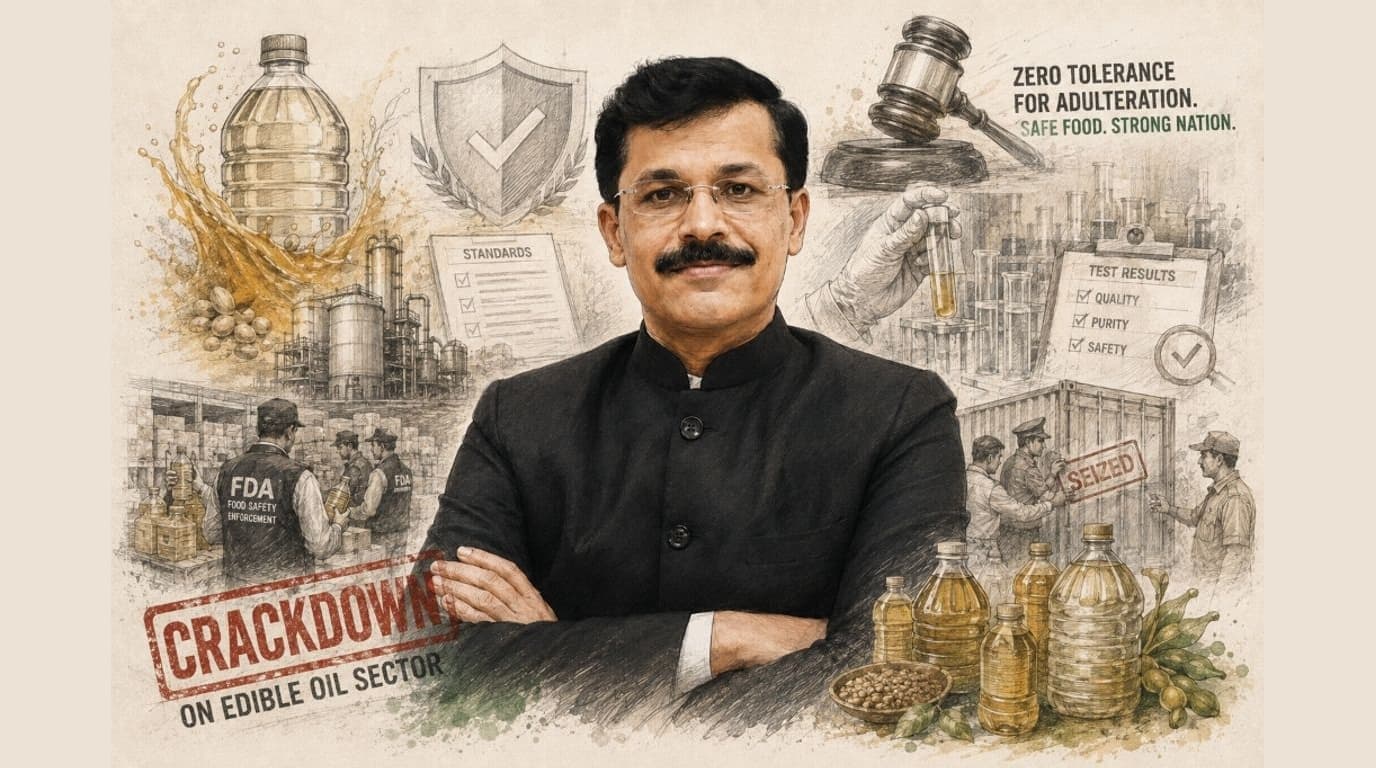
“Food safety cannot be a paper inspection checklist. When unbranded loose oils, chemical neutralization with caustic soda, and repeatedly burnt frying oils flood the market, consumers unknowingly pay with their cardiovascular health. True quality must be scientifically verifiable.”
Maharashtra’s food safety ecosystem has received an uncompromising wake-up call. Under Food and Drug Administration (FDA) Commissioner Tukaram Mundhe—an administrator renowned for relentless bureaucratic enforcement—the edible oil market has come under state-wide scrutiny.
Raids across manufacturing facilities, unorganized repackaging warehouses, and bulk distributors have exposed an alarming industry reality: unauthorised blending of cheap palm fractions, widespread trade of unsealed loose oil in rusty drums, misleading labeling, and commercial fryers reusing burnt oil far beyond safety limits.
The FDA’s directives have mandated tamper-evident sealed packaging across the supply chain, strict batch traceability, and severe penal action against adulterated edible oils. For millions of Indian families watching the viral news clips of seized tankers, one critical question hits home:
Every time you heat cooking oil in your kadhai, do you truly know how it was processed—and what is inside that bottle?
The Dark Side of Cheap Cooking Oil: What the Raids Uncovered
For years, price wars in the edible oil aisle encouraged a race to the bottom. Unscrupulous players exploited weak oversight to cut corners, creating major health hazards:
1. The Hazard of Loose Oil
Loose oil sold in open tins allows unrestricted adulteration with prohibited substances such as toxic Argemone oil, cheap castor fractions, or non-edible hydrocarbon lubricants without any batch testing or legal accountability.
2. Toxic Reheating (High TPC)
Repeatedly heated oil forms Total Polar Compounds (TPC). FSSAI prohibits using oil exceeding 25% TPC because thermal oxidation generates carcinogenic polymers and polycyclic aromatic hydrocarbons (PAHs).
3. Harsh Chemical Neutralization
Conventional chemical refining uses Caustic Soda (Sodium Hydroxide - NaOH) and acid-activated clay to neutralize fatty acids. This aggressive chemical bath strips out natural antioxidants and native micronutrients.
The Purity Benchmark: Chemical vs. 100% Physical Refining
As the FDA cracks down on questionable blending, understanding the refining process is the ultimate consumer defense. Not all refined oils are created equal:
| Inspection Parameter | Unbranded / Loose Oil | Conventional Chemically Refined | 100% Physically Refined |
|---|---|---|---|
| Refining Method | Unknown / Unregulated | Caustic Soda (NaOH) + Acid Bleach | High-Vacuum Steam Distillation |
| Chemical Residues | High contamination risk | Trace neutralizing chemical exposure | Zero Harsh Chemicals Used |
| Micronutrient Retention | Destroyed or adulterated | Largely stripped during alkali wash | Natural Gamma Oryzanol & Vitamin E Intact |
| Smoke Point & Thermal Safety | Low & erratic (< 180°C) | Moderate (200°C - 215°C) | Ultra-High 232°C (450°F) Stability |
| Packaging & Traceability | Unsealed drums (Banned by FDA) | Standard retail pouches | Tamper-Evident Sealed Bottles / Cans |
The 4-Step Consumer Audit: How to Buy Safely After the Crackdown
Tukaram Mundhe’s campaign makes one thing clear: consumers must become proactive quality auditors in their own kitchens. Here are the four checks to make before purchasing cooking oil:
1. Look Specifically for “Physically Refined”
Check the ingredient label on the back panel. If the pack states “Refined with Permitted Food Grade Neutralizers”, it was subjected to chemical alkali processing. Physical Refining uses pure steam distillation under vacuum to deodorize and deacidify the oil without any corrosive caustic soda.
2. Insist on Sealed, Tamper-Evident Packaging
Never purchase unbranded oil from loose containers or repacked jerrycans. Authentic manufacturers use food-grade PET bottles or sealed tins with verifiable FSSAI license numbers, batch codes, and tamper-proof inner pull-ring caps that make tampering impossible.
3. Look for Natural Bioactive Biomarkers
Adulterated oils cannot fake naturally occurring micronutrient biomarkers. In pure Physically Refined Rice Bran Oil, the presence of 10,000 to 12,000+ PPM Gamma Oryzanol serves as a natural fingerprint of authenticity. Oryzanol supports healthy cholesterol metabolism and cannot be artificially infused into cheap blends.
4. Demand NABL-Accredited Lab Verification
Check whether the brand operates certified quality testing facilities. In our state-of-the-art NABL-accredited analytical laboratoryin Burdwan, every production batch is screened using gas chromatography for zero argemone oil, zero mineral oils, ultra-low Free Fatty Acids (≤ 0.089%), and zero rancidity before it ever reaches a store shelf.
The Shift From Cheap Price to Verifiable Trust
The enforcement wave led by Tukaram Mundhe proves that edible oil cannot be treated as an anonymous, untraced commodity. When regulators enforce transparency, the market changes for good.
The era of buying whatever is cheapest at the corner shop is giving way to conscious choices. For families who care about long-term wellness, avoiding carcinogenic reheated oils and chemical refining is no longer an optional luxury—it is fundamental preventative healthcare.
The future of edible oil belongs to whoever can prove what is inside the bottle. When you insist on 100% physical steam refining, tamper-evident seals, and verified natural bioactives, you ensure that every meal cooked for your family is pure, safe, and uncompromised.
Frequently Asked Questions (FAQ)
What is the Maharashtra FDA order regarding loose edible oil sales?
Under FDA Commissioner Tukaram Mundhe, Maharashtra has strictly reinforced the ban on retailing edible oil in loose, unsealed tins or open plastic containers. All cooking oils must be distributed and sold in sealed, tamper-evident food-grade packaging with verified FSSAI batch numbers and manufacturer traceability.
Why is repeated heating of cooking oil dangerous?
When cooking oil is repeatedly heated past its thermal limit, it forms toxic compounds known as Total Polar Compounds (TPC). FSSAI mandates an upper limit of 25% TPC; oil exceeding this threshold produces harmful free radicals, oxidized polymers, and acrylamides linked to vascular inflammation, heart disease, and cellular toxicity.
How does 100% physical refining protect cooking oil purity without chemicals?
Unlike conventional chemical refining which treats crude oil with caustic soda (sodium hydroxide) and harsh bleaching acids, physical refining relies exclusively on high-vacuum steam distillation at controlled temperatures. This non-chemical process eliminates free fatty acids while preserving natural micronutrients like Gamma Oryzanol, Tocopherols, and Phytosterols.
Why does Gamma Oryzanol serve as a natural purity biomarker in cooking oil?
Gamma Oryzanol is a potent natural antioxidant found inherently in rice bran oil (typically 10,000 to 12,000+ PPM). Because synthetic blending and cheap adulterants cannot replicate this delicate bioactive compound, lab-tested Gamma Oryzanol content acts as an unmistakable seal of authentic, uncompromised refining.